
The Poetry of Brian Bilston

Brian Bilston has been frequently described as the 'Poet Laureate of Twitter.' He remains  a poet clouded in  mystery. He possesses a Banksy type persona. Very little is known about him other than the fragments of information revealed on social media and through his poetic offerings. 
In 2014 he became the first person to retain the title of Pipe Smoker of the Year [Poetry section] and, over the years, he has won numerous awards  He won the 2015 Great British Write Off poetry prize for a poem disguised in a Venn diagram.


His first collection of poetry 'You Caught the Last Bus Home'  has now been published. Bilston has been described as wordsmith who takes great pride in his use of language, making words dance before the reader's eyes. He is bringing poetry to the masses through social media employing topical, witty, thoughtful and very accessible poetry. Perhaps the most famous of his poems is the powerful message contained in  'Refugee.'

I have just taken receipt of his book and it meets all expectations. As an avid collector of poetry books, this book is a delightful and informative acquisition. I am an avowed Bilston fan.

Bilston's observational take on life is both entertaining and perceptive. You can find out more about the mysterious Brain Bilston by visiting: https://brianbilston.com/category/twittle-poems/
Here are three examples of the Bilston style:
POETIC LICENCE
Not being well-versed
In the world of poetry,
A pastry chef,
By the name of Geoff,
Went to purchase
A poetic licence
In order to surprise
His patrons
With chicken
And mushrhyme pies.

THERE’S A SUPERMARKET WHERE THE LIBRARY ONCE STOOD
There’s a supermarket where the library once stood.
I sometimes forget that it’s now gone for good.
Last week I asked if they had any Flaubert.
A shrug in response. ‘The cheese counter’s there.’
There’s a supermarket where the library had been.
I’ve been reading some Dhal in ‘Indian cuisine’.
No golden tickets, witches or giants, of course;
just chickpeas and lentils in a creamy spiced sauce.
There’s a supermarket where the library once was.
I had tried to hand back an old Grapes of Wrath.
Sorry, they told me, but it’s really too late,
they’ll be shrivelled and well past their best-before-date.
There’s a supermarket where the library once stood.
A Sainsbury’s Local has bulldozed my childhood.
The library had been starved of state funding, I guess.
Take books off the menu and live well for less.

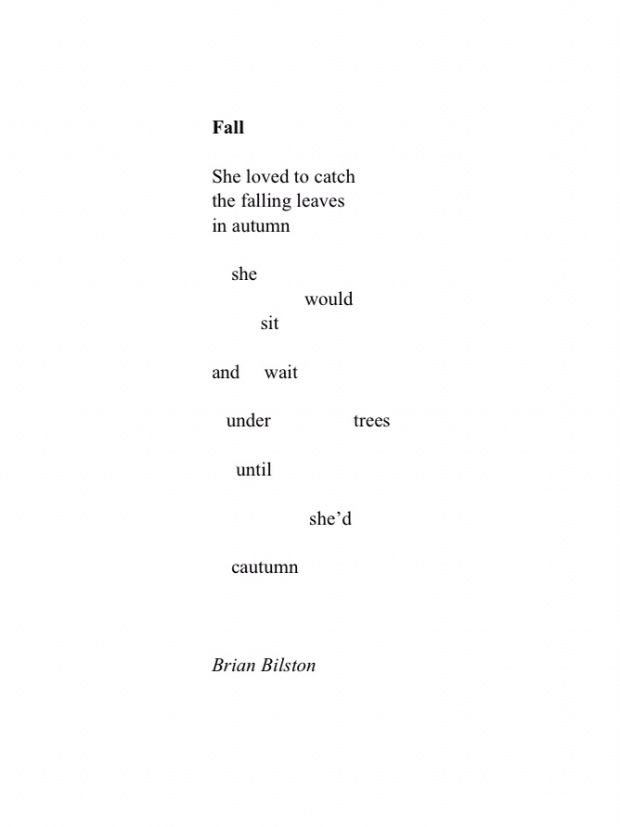
AUTUMN


Comments

  1. Oh, I can see why you're an avowed fan. He's wonderful! So clever and playful, but also deep, or as you said, "perceptive." Thanks so much for the introduction. I think it's going to be the beginning of a beautiful relationship!

    ReplyDelete
    Replies
    1. Molly meet Brian! Glad you liked what you saw and saw what you liked. I knew I wouldn't be the only one who thinks Brian's words hit the mark.

      Delete
  2. Hahaha--awesome! Makes me think of Kenn Nesbitt and Brod Bagert. Thanks for the introduction!

    ReplyDelete
    Replies
    1. I know both poets you mention Laura and yes, they possess similar perspectives when writing.

      Delete
  3. Loved the wordplay/spunky ending in his last poem, thanks Alan!

    ReplyDelete

Post a Comment

Popular posts from this blog

Poetry Inspired by Images and Objects

There are many ways pictures and photographs can be conscripted to support the writing of poetry. Allow me to share a few ideas with you: Old photographs are a great source of inspiration. Cynthia Rylant explored this idea with great success in her book 'Something Permanent' where she employed the Depression era photographs of Walker Evans to add a new voice to the starkness to the lives of people experienced under extreme circumstances. I have used this strategy to spark many individual poems. In ' I Bet There's No Broccoli On The Moon,' I used a photo I had taken in 2004 while living in New York to inspire a poem. The poem was based on a story related by a friend who grew up in New York.  I regularly combined poetry and pictures in my writer's notebook, drawing on inspiration from the photograph and my personal memories. We can also utilize existing cartoons and illustrations to create ekphrastic poems. I frequently use the illustrations of Jim Pavlidis to co...

Peter Dixon -Teabag Poem

Today I'm highlighting the poetry of Peter Dixon. Peter Dixon was not just a poet. He was a performer, educationalist and artist.   He grew up in London during WW2, and as a boy his schooling was far from successful. He struggled with spelling and the understanding of word, form and grammar, so he tended to write secretly at home, drawing and writing of things largely ignored by schools.   Despite this difficult phase of his life, Peter eventually became a school teacher and then a senior lecturer in education. It often mystified him as to how all of this came to pass. As a teacher, he strived to be unbiased and did not neglect the children who experienced learning challenges.   Peter Dixon became a full time children’s writer and educational consultant. His first book was published in 1978. Whilst living in Winchester, Hampshire, with his family, he   contributed to over 100 poetry anthologies and had seven collections of his own work published including Grow Your O...

Poetry Friday 'Storm On The Island' Seamus Heaney

Given the fact that we recently celebrated St Patrick's Day, it seems appropriate that I take this opportunity to continue the Irish focus and recognize one of Ireland's leading literary figures... Seamus Heaney was born in County Derry in Northern Ireland in 1939 and died in 2013. He became a multi award winning poet. His first collection of poems, 'Death of a Naturalist' appeared in 1966 and helped to establish Heaney as one of the major poets of the 20th century. From that first anthology, I have chosen 'Storm On The Island.' This poem tells us about the stoic resistance of people and structures to an incoming storm. The island is not named. Poetic scholars believe this is a poem that can be taken literally, as a monologue on the life and attitude of island people facing a storm, or it can be understood as a  metaphor of political struggle on the island of Ireland. Heaney knew both worlds.  The poems of this first collection are grounded in the soil...