
Poetry and Food -Poetry Friday


I want to share a poem today from Eve Merriam, titled, 'How to Eat a Poem.' In this short poem, Eve Merriam invites us to embrace an appetite for both food and poetry. I found this poem at the back of a book called 'Eat This Poem- a Literary Feast of Recipes Inspired by Poetry, by Nicole Gulotta. The poem provides a fitting final piece in this in this artful book.

 The book, a gift from a friend, celebrates two of life's essential ingredients- food and poetry. My friend knows me extremely well. The book strikes a continuing chord in my personal life.  

Connecting food and poetry opens up fresh ways for readers to access poetry as well as adding deeper meaning to the food we cook for family and friends.
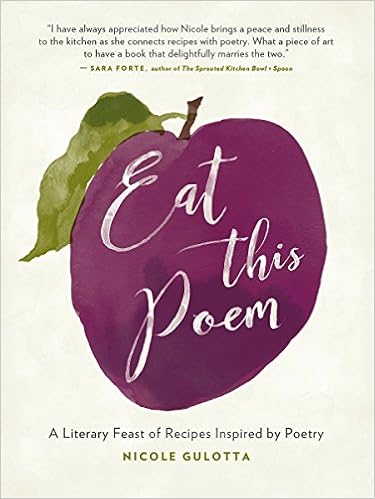
Image result for Eat This Poem

This book is a wonderful gift for poetry lovers and doubly so for those with a passion for food and cooking. I have no wish to analyse this poem. I merely offer it to you as one would offer a guest a tasty delight. Bon appetit!

How To Eat a Poem
by Eve Merriam

Don't be polite
Bite in
Pick it up with your fingers and lick the juice that
may run down your chin.
It is ready and ripe now, whenever you are.

You do not need a knife or fork or spoon
or plate or napkin or tablecloth

For there is no core
or stem
or rind
or pit
or seed
or skin
to throw away.

Comments

Popular posts from this blog

Poetry Inspired by Images and Objects

There are many ways pictures and photographs can be conscripted to support the writing of poetry. Allow me to share a few ideas with you: Old photographs are a great source of inspiration. Cynthia Rylant explored this idea with great success in her book 'Something Permanent' where she employed the Depression era photographs of Walker Evans to add a new voice to the starkness to the lives of people experienced under extreme circumstances. I have used this strategy to spark many individual poems. In ' I Bet There's No Broccoli On The Moon,' I used a photo I had taken in 2004 while living in New York to inspire a poem. The poem was based on a story related by a friend who grew up in New York.  I regularly combined poetry and pictures in my writer's notebook, drawing on inspiration from the photograph and my personal memories. We can also utilize existing cartoons and illustrations to create ekphrastic poems. I frequently use the illustrations of Jim Pavlidis to co...

Powerful Poetry, 'Refugees' by Brian Bilston

  This week, Poetry Friday is hosted by Janice Scully  @ Salt City Verse where Janice shares some original words and offers us a taste of Thomas Carlyle to ponder. I encourage you to join a host of poets from all around the globe and visit Janice's page... Almost two years to the day, I wrote a post featuring the poem 'Refugees' by Brian Bilston. The poem was included in Brian's first book of poetry, 'You Took The Last Bus Home.' A very powerful Reverso poem and technically brilliant.  A Reverso poem can be read from top to bottom or bottom to top. It will often express opposite opinions depending on which way you read it. Such poems really make us think. A Reverso poem is like a picture turned upside down, a frowning face upended to reveal a smiling one. The poem read in reverse, contradicts itself with an opposing message. In 'Refugee' Brian Bilston focuses on a societal issue that tends to polarize feelings and the opposing views are clearly in eviden...

Poetry Friday 'Storm On The Island' Seamus Heaney

Given the fact that we recently celebrated St Patrick's Day, it seems appropriate that I take this opportunity to continue the Irish focus and recognize one of Ireland's leading literary figures... Seamus Heaney was born in County Derry in Northern Ireland in 1939 and died in 2013. He became a multi award winning poet. His first collection of poems, 'Death of a Naturalist' appeared in 1966 and helped to establish Heaney as one of the major poets of the 20th century. From that first anthology, I have chosen 'Storm On The Island.' This poem tells us about the stoic resistance of people and structures to an incoming storm. The island is not named. Poetic scholars believe this is a poem that can be taken literally, as a monologue on the life and attitude of island people facing a storm, or it can be understood as a  metaphor of political struggle on the island of Ireland. Heaney knew both worlds.  The poems of this first collection are grounded in the soil...